LPR enforcement designed to protect the paid parker.
Bring your own LPR cameras and push reads into nfors. Configured workflows check available permit data, apply guarded handling for common camera confusions, and retain grace and decision context for review.
Automated reads, adjudicated the right way.
Bring your own cameras
nfors exposes a documented REST endpoint for compatible LPR/ALPR systems and can return supported lifecycle events through HMAC-signed webhooks.
Permit match before any charge
Configured workflows run exact, state-fallback, and guarded confusable-character checks against available permit data before issuance.
Misread-tolerant by design
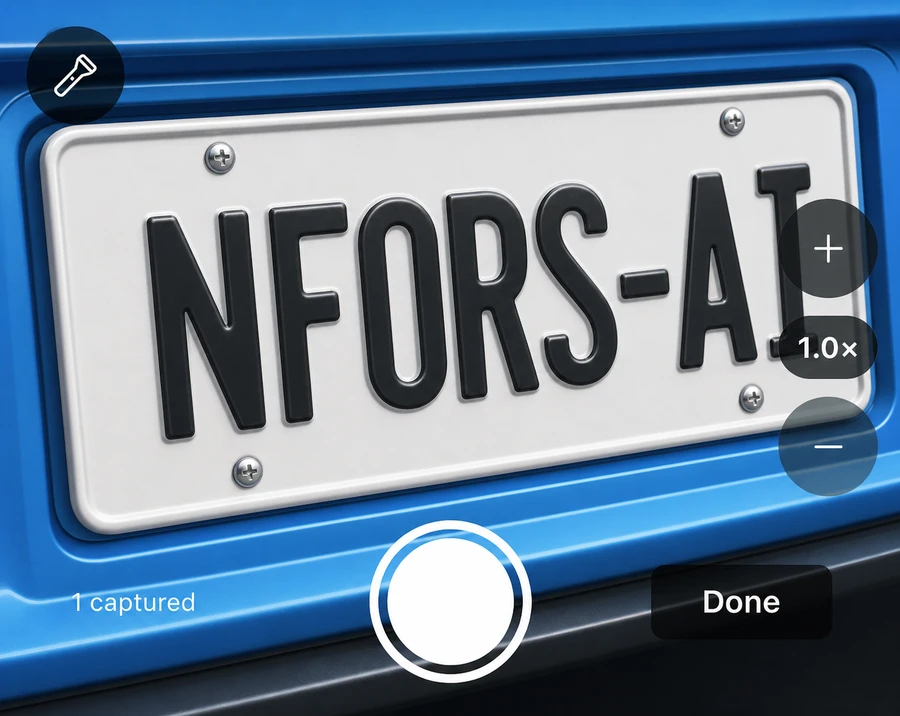
Common LPR confusions (O↔0, I↔1, B↔8, S↔5, Z↔2) use a single-candidate guard; ambiguous results remain unmatched for human review.
The grace gate applies to cameras too
Configured camera workflows can place unmatched reads in a timed queue using operator settings and jurisdiction policy inputs.
Fix a misread, auto-void the charge
A supervisor correction can trigger a permit re-check; qualifying matches can void the charge and cancel configured downstream collection work.
Officers and cameras, one pipeline
LPR-captured and field-captured records can share the same policy, payment, collections, dispute, and decision-history model.
Reads in, decisions out.
Whether a fixed camera or an officer’s phone captured the plate, nfors can read it, check available permit data, and triage unmatched results for review.
- A confidence threshold routes uncertain reads to a human, not an automatic charge
- Permit data is aggregated from multiple providers into one match
- Accepted reads and resulting decisions can be retained for dispute review
Recent
Low confidence — confirm later

Common questions
Does nfors sell or operate LPR cameras?
No. nfors is bring-your-own-camera software. A compatible LPR/ALPR system sends plate reads to the nfors API for ingestion and matching; camera hardware and integration validation remain the operator’s responsibility.
How does nfors avoid ticketing drivers who already paid?
Configured issuance workflows check available permits and whitelists with exact, state-fallback, and guarded confusable-character matching. Matches return no action, while unmatched results proceed through the applicable review and grace workflow.
Is LPR enforcement real-time?
Push and webhook reads are processed when received. Permit freshness depends on the source: pushed data can update promptly, while polled providers refresh on their configured cadence and should not be described as instantaneous.
Which cameras and platforms are supported?
LPR systems that can send the documented request format can be evaluated for integration. Available permit connectors include Level Parking, Parkmobile, and ParkLync, and operators can also supply permit and whitelist data through the API.
Turn camera reads into defensible charges.
Free for 90 days, no credit card. Start with self-serve operator setup.